Showing posts with label aurora. Show all posts

Thursday, June 20, 2013

Report for 6/20/13

There is currently a large coronal hole on the Sun, which is intensifying the solar wind stream heading to Earth (see image).  This activity may cause auroras for sky watchers in higher latitudes from June 23-24.

On June 18, NASA's STEREO B satellite captured footage of a solar flare and CME on the back of the Sun.  The active region these events stemmed from is rotating to the front of the Sun and it could potentially cause Earth-directed solar events.


Do you predict there will be any space weather events in the next 24 hours?  Submit your forecast!

SDO captured this image of a large coronal hole (dark area) on the Sun today.


Thursday, April 26, 2012

Report for 4/26/12

There was a lunar transit on Saturday, which was captured by NASA Solar Dynamics Observatory (SDO) cameras.  The picture below was taken by SDO in extreme ultraviolet light.

On Monday and Tuesday, geomagnetic storms (Kp=5-6) occurred as a result of a coronal mass ejection (CME) that blasted by the Earth.  The solar activity caused auroras, which could be seen as far south as Colorado and Nebraska in the US.

Do you predict there will be any space weather events in the next 24 hours?  Submit your forecast!

 
Saturday's lunar transit as seen by NASA SDO.

Friday, March 16, 2012

Report for 3/16/12

Sunspot AR1429, which caused a flurry of solar events last week, unleashed a massive M8-class solar flare on March 10th and M7-class flare on March 13th. The latter blast was followed by a coronal mass ejection (CME) that caused yesterday's geomagnetic storm (Kp=6). AR1429 has been so active that sky watchers in the Arctic Circle have witnessed auroras for almost two weeks straight.

Comet SWAN, a Kreutz sungrazer comet, rocketed toward the Sun on March 14th, but did not survive. This comet was much smaller than Comet Lovejoy
, a sungrazer comet that got a great deal of attention last December for making it around the Sun and surviving its journey.

Do you think there will be any major solar events this weekend? Submit your forecast and let us know what you think!

Comet SWAN (bottom left) races to the Sun (blocked out by center disc).
SOHO captured this footage on March 14th.

Friday, February 17, 2012

Report for 2/17/12

Early in the week, sunspot AR1402 returned after a two-week trip around the back of the Sun. This sunspot (which has since been renamed AR1419) was the source of a major X-class solar flare on Jan. 27, but has since significantly decreased in size; it gave off only B- and C-class flares this week.

A geomagnetic storm (Kp=5) began early on Feb. 15th and gave sky watchers as far south as Minnesota the chance to see auroras. The Sun remained quiet the rest of the week and remains that way today. Do you think that a space weather event will occur over the weekend? Submit your forecast and let us know!

Today's Sun is quiet, but is still amazing to look at!

Friday, February 10, 2012

Report for 2/10/12

The Sun started the week off strong with a powerful coronal mass ejection (CME) and M1-class solar flare on Monday. Mid-week, a moderate solar wind stream flowed to Earth leading NOAA forecasters to predict a 40% chance of a geomagnetic storms in the higher latitudes. No major storm activity occurred, but sky watchers around the Arctic Circle were treated to vibrant auroras.

Last night, a filament on the Sun's northeastern limb exploded, causing a CME that is currently heading toward Venus. Although the blast is not headed our way, a new sunspot located near the blast site may be a potential source of solar activity in the upcoming week.

What do you think this weekend's space weather will be? Submit your forecast!


Today's Sun as seen by the Solar Dynamics Observatory.

Friday, January 27, 2012

Report for 1/27/12

This week was an exciting one for space weather fans! On Monday, sunspot AR1402 caused an M9-class solar flare followed by a coronal mass ejection (CME). The CME, which hit Earth's magnetic field on Tuesday, caused a geomagnetic storm; the storm created beautiful auroras for sky watchers as far south as South Dakota and Michigan in the US.

Yesterday, a CME was released from the Sun over its north pole, although it is not heading toward Earth. Earth is also safe from the effects of the powerful X2-class flare and CME that sunspot AR1402 unleashed today. This sunspot is on the far side of the Sun, so its recent activity has not been aimed at us.

A solar wind stream is expected to arrive over the weekend, which may cause some disruptions in Earth's magnetic field. What are your predictions for this weekend's space weather? Make your forecast here!

An X2-class solar flare and CME erupted today.

Friday, January 13, 2012

Report for 1/13/12

Over half of the Camilla Space Weather Project forecasters predicted a 60-80% chance of a solar event last week. Good job, forecasters! There were C-class solar flares on Jan. 9 and Jan. 12!

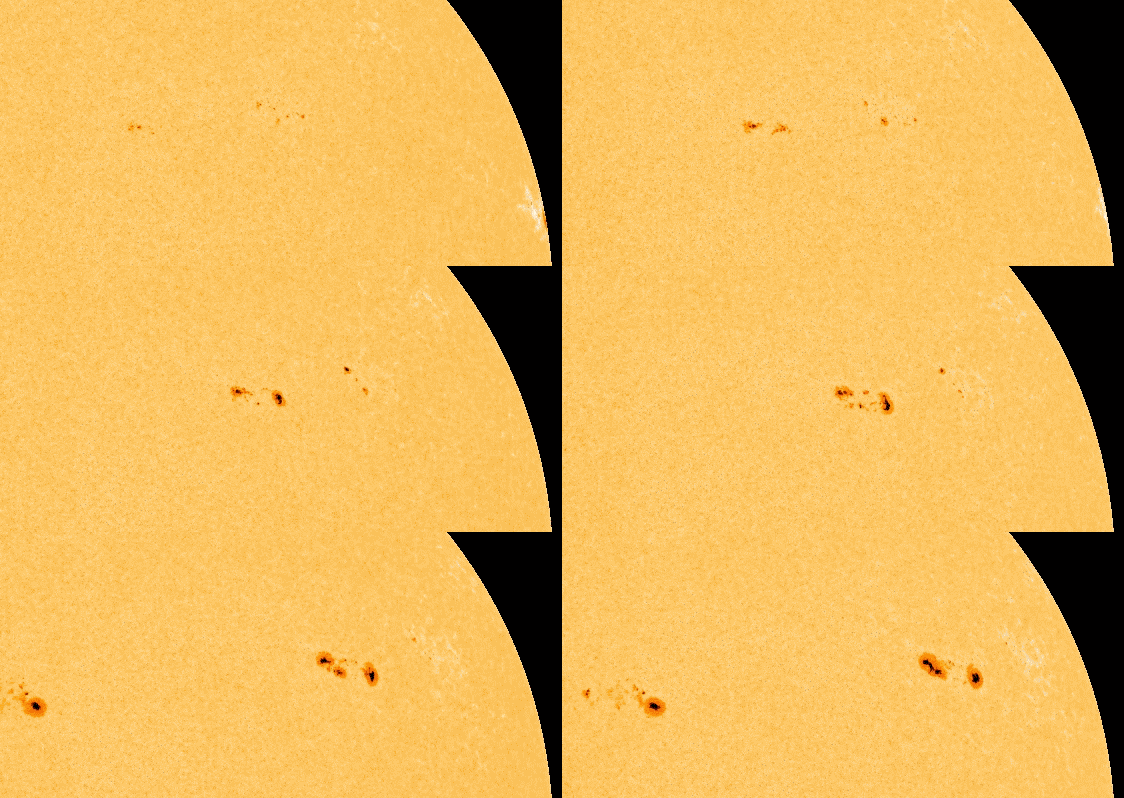
Last weekend, the Solar Dynamics Observatory (SDO) captured footage of sunspot AR1393 tripling in size in just over two days, growing to be about five times the width of Earth (see video)! Despite its size, this sunspot did not produce much activity. On the other hand, on Jan. 9, sunspot AR1395 caused a C-class solar flare when its magnetic field untwisted!

Sunspot AR1393 tripled in size last weekend!

A minor solar wind stream caused beautiful auroras around the Arctic Circle on Jan. 10. The Sun put on another show yesterday with an eruption on its far side, which caused a C-class flare (see image below). The active region that caused the eruption and flare will be turning toward Earth over the weekend; do you think it will cause any other events? Make your predictions here!

This active region produced a flare on Jan. 12 and will soon face Earth.

Friday, December 30, 2011

Report for 12/30/11

On December 25-26th, two coronal mass ejections (CMEs) were released from the Sun within 24 hours of each other! This caused geomagnetic storms on December 28th; sky watchers in the higher latitudes were treated to spectacular auroras.

Sunspot AR1389 unleashed two M-class solar flares yesterday and may not be done yet. Two other sunspots, AR1386 and AR1387, also have the potential to cause a solar event; AR1387 was the source of the CME on Dec. 25th. The NOAA Space Weather Prediction Center has predicted a 40% chance of M-class flares through tomorrow.

What do you think the chances of a solar event are over the weekend? Submit your forecast here!


Auroras decorated the sky on December 28, 2011.


Friday, December 2, 2011

Report for 12/2/11

Great job, forecasters! There have been no major solar events in the past 24 hours, which 17% of you accurately predicted!

Also impressive is the fact that nearly half of you made the same prediction as scientists at the NOAA Space Weather Prediction Center; they forecasted a 20-30% chance of flares (see table above).

Last Saturday (Nov. 26), a solar flare hurled a coronal mass ejection (CME) at about 2 million mph into Space, which reached us on Monday. Spectacular auroras were seen in higher latitudes!

The sun is currently quiet, but what will the weekend hold? Submit your forecasts and let us know what you think!
A picture of Saturday's CME taken by SOHO.

Wednesday, November 23, 2011

Report for 11/23/11

In late October, the Sun was so active that auroras could be seen as far south as Arkansas and Arizona in the US! The Sun has been putting on less of a performance so far this month, although yesterday a prominence erupted which was several times the size of the Earth! Although not Earth-facing, it was a beautiful sight (video).

A picture of yesterday's prominence eruption taken by SDO.

According to the NOAA Space Weather Prediction Center, there is a 30% chance of M-class solar flares in the next few days, but otherwise solar activity is expected to be low. Forecasters are keeping their eyes on sunspot 1356 as a potential source of flares.

Sunspot 1356 is currently a potential source of flares.