The Sun was pretty quiet this week, with virtually no sunspots on Tuesday! This shows that although we are approaching solar max, there can still be periods of intense quiet on the Sun. The largest solar flare that occurred was a C-class blast on Monday; a coronal mass ejection (CME) that was expected to hit Earth on that same day missed, so geomagnetic activity was low this week.
A few sunspots have appeared on the Sun in the last few days, which may cause some increased activity. Do you think there will be any space weather events in the next 24 hours? Submit your forecast and let us know!
Thursday, April 12, 2012
Friday, April 6, 2012
Report for 4/6/12
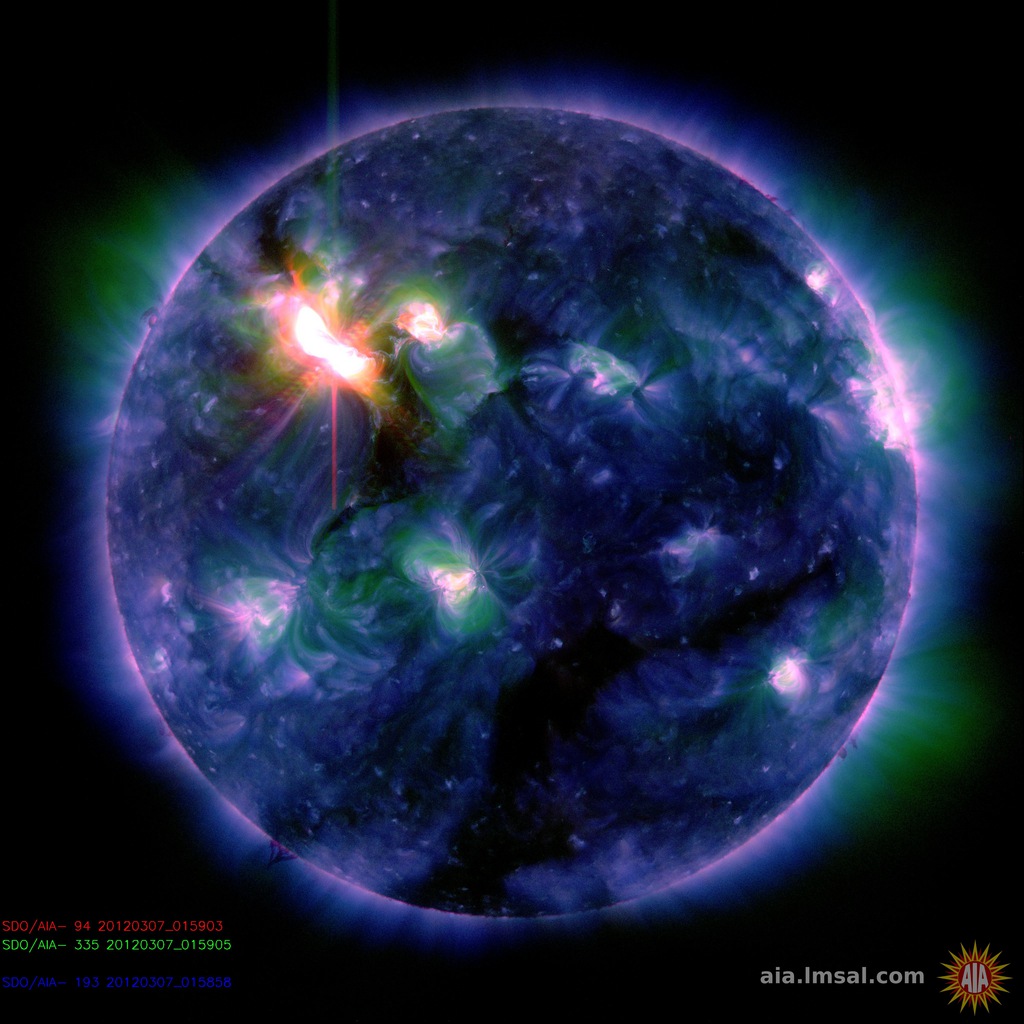
Although sunspot AR1429 recently returned from its journey around the backside of the Sun, solar activity has been low this week. This sunspot (which has since been renamed AR1451) was the source of over 50 solar flares from March 2nd to 15th, but has significantly decreased in size over the past few weeks.
A coronal mass ejection (CME) that erupted from the Sun on April 2nd was predicted to hit Earth two days later, but there have been no signs of it yet. It is possible it missed Earth, but we are still on the lookout for it.
The Sun also did a 360 degree roll this week. Just kidding! Although it appears the Sun did a somersault, NASA's Solar Dynamics Observatory (SDO) actually did. Twice a year, the SDO spacecraft does a 360 degree roll about the spacecraft-Sun line; this maneuver allows scientists to identify optical distortions in solar images. It also enables them to determine if the Sun's sphere is changing over time as a result of the solar cycle.
A coronal mass ejection (CME) that erupted from the Sun on April 2nd was predicted to hit Earth two days later, but there have been no signs of it yet. It is possible it missed Earth, but we are still on the lookout for it.
The Sun also did a 360 degree roll this week. Just kidding! Although it appears the Sun did a somersault, NASA's Solar Dynamics Observatory (SDO) actually did. Twice a year, the SDO spacecraft does a 360 degree roll about the spacecraft-Sun line; this maneuver allows scientists to identify optical distortions in solar images. It also enables them to determine if the Sun's sphere is changing over time as a result of the solar cycle.
Thursday, March 22, 2012
Report for 3/22/12
There was a powerful coronal mass ejection (CME) released from the Sun on Sunday, the source being sunspot AR1429. The sunspot, which has been active for several weeks, has been turning to the backside of the Sun and so the CME was not Earth-directed.
Midweek there was an electron storm; there was an increased number of excited electrons in the Earth's outer radiation belt. The NASA Goddard Space Weather Lab determined that this was caused by a combination of a solar wind stream and geomagnetic storm activity that Earth experienced recently. Satellites that travel near the radiation belts during these storms could be adversely affected.
Today there is a 15% chance of geomagnetic storms in the higher latitudes according to NOAA. Do you think there will be any major solar events through the weekend? Submit your forecast and let us know! Results will be posted on the home page next week!
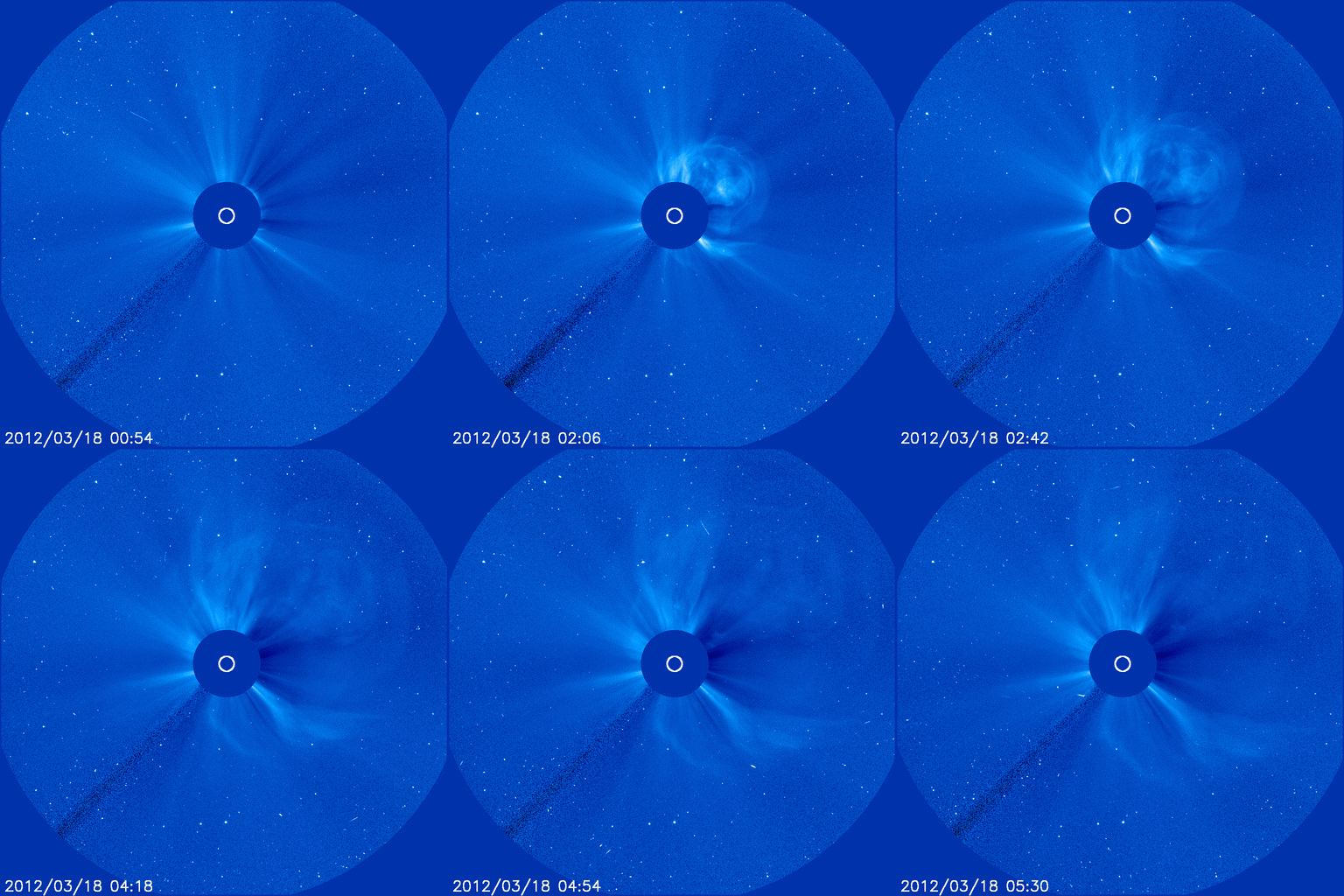
SOHO captured footage of a coronal mass ejection on March 18th.
The disc in the middle is covering the Sun.
Midweek there was an electron storm; there was an increased number of excited electrons in the Earth's outer radiation belt. The NASA Goddard Space Weather Lab determined that this was caused by a combination of a solar wind stream and geomagnetic storm activity that Earth experienced recently. Satellites that travel near the radiation belts during these storms could be adversely affected.
Today there is a 15% chance of geomagnetic storms in the higher latitudes according to NOAA. Do you think there will be any major solar events through the weekend? Submit your forecast and let us know! Results will be posted on the home page next week!
SOHO captured footage of a coronal mass ejection on March 18th.The disc in the middle is covering the Sun.
Friday, March 16, 2012
Report for 3/16/12
Sunspot AR1429, which caused a flurry of solar events last week, unleashed a massive M8-class solar flare on March 10th and M7-class flare on March 13th. The latter blast was followed by a coronal mass ejection (CME) that caused yesterday's geomagnetic storm (Kp=6). AR1429 has been so active that sky watchers in the Arctic Circle have witnessed auroras for almost two weeks straight.
Comet SWAN, a Kreutz sungrazer comet, rocketed toward the Sun on March 14th, but did not survive. This comet was much smaller than Comet Lovejoy, a sungrazer comet that got a great deal of attention last December for making it around the Sun and surviving its journey.
Do you think there will be any major solar events this weekend? Submit your forecast and let us know what you think!
Comet SWAN (bottom left) races to the Sun (blocked out by center disc).
SOHO captured this footage on March 14th.
Comet SWAN, a Kreutz sungrazer comet, rocketed toward the Sun on March 14th, but did not survive. This comet was much smaller than Comet Lovejoy, a sungrazer comet that got a great deal of attention last December for making it around the Sun and surviving its journey.
Do you think there will be any major solar events this weekend? Submit your forecast and let us know what you think!
Comet SWAN (bottom left) races to the Sun (blocked out by center disc). SOHO captured this footage on March 14th.
Labels:
aurora,
CME,
comet,
geomagnetic storm,
M-class,
solar flare,
sunspot
Friday, March 9, 2012
Report for 3/9/12
Massive sunspot AR1429 has been very active this week, unleashing several intense solar flares and coronal mass ejections (CMEs). The sunspot released an X1-class solar flare and CME on Monday. It followed that up with an X5-class solar flare and CME on Wednesday, which was Earth-directed; the blast is the cause for today's geomagnetic storm activity.
AR1429 is currently more than seven times the width of Earth and is still growing! (As of Sunday, it was approximately four times Earth's width.) NOAA forecasters predict an 80% chance of M-class flares and 40% chance of X-class flares in the next 24 hours.
What do you predict? Submit your forecast today!
AR1429 is currently more than seven times the width of Earth and is still growing! (As of Sunday, it was approximately four times Earth's width.) NOAA forecasters predict an 80% chance of M-class flares and 40% chance of X-class flares in the next 24 hours.
What do you predict? Submit your forecast today!
Friday, February 24, 2012
Report for 2/24/12
This week was pretty exciting! On Tuesday, the Solar Dynamics Observatory (SDO) captured stunning shots of the Lunar Transit (see images below). On Thursday, a "solar tsunami" erupted from the Sun, which released a burst of plasma into space at an incredible speed of approximately 250 km/s. A filament erupted this morning causing a coronal mass ejection (CME) to be hurled into space, but it is not headed for Earth and should not affect us.
Friday, February 17, 2012
Report for 2/17/12
Early in the week, sunspot AR1402 returned after a two-week trip around the back of the Sun. This sunspot (which has since been renamed AR1419) was the source of a major X-class solar flare on Jan. 27, but has since significantly decreased in size; it gave off only B- and C-class flares this week.
A geomagnetic storm (Kp=5) began early on Feb. 15th and gave sky watchers as far south as Minnesota the chance to see auroras. The Sun remained quiet the rest of the week and remains that way today. Do you think that a space weather event will occur over the weekend? Submit your forecast and let us know!
Friday, February 10, 2012
Report for 2/10/12
The Sun started the week off strong with a powerful coronal mass ejection (CME) and M1-class solar flare on Monday. Mid-week, a moderate solar wind stream flowed to Earth leading NOAA forecasters to predict a 40% chance of a geomagnetic storms in the higher latitudes. No major storm activity occurred, but sky watchers around the Arctic Circle were treated to vibrant auroras.
Last night, a filament on the Sun's northeastern limb exploded, causing a CME that is currently heading toward Venus. Although the blast is not headed our way, a new sunspot located near the blast site may be a potential source of solar activity in the upcoming week.
What do you think this weekend's space weather will be? Submit your forecast!
Last night, a filament on the Sun's northeastern limb exploded, causing a CME that is currently heading toward Venus. Although the blast is not headed our way, a new sunspot located near the blast site may be a potential source of solar activity in the upcoming week.
What do you think this weekend's space weather will be? Submit your forecast!
Labels:
aurora,
CME,
filament,
M-class,
solar flare,
solar wind,
sunspot
Subscribe to:
Posts (Atom)